What Is Website SEO Optimization And How Does Search Engine Promotion Work?

You can create a modern website with an attractive design, a convenient catalog, and useful content, yet still receive no traffic from Google. This happens when a search engine cannot find individual URLs, correctly analyze their content, or determine which queries they should appear for.
SEO is a set of activities that help search engines find, crawl, index, and understand sections of a website, while helping users receive relevant answers to their queries. In simple terms, SEO makes a website more visible in organic search results and attracts people who are already looking for a particular product, service, or piece of information.
SEO stands for Search Engine Optimization. Therefore, website SEO optimization is the technical, structural, content-related, and link-based development of a website in line with search engine requirements and audience needs.
What Is SEO in Simple Terms?

Imagine that a website is a store located in a large city. It is not enough to open it and design it attractively. Potential customers must know where it is, be able to reach it easily, and find the product they need once they arrive.
Website promotion begins with understanding the audience: the website must provide a useful answer, while optimization should take competitors’ solutions into account. This is why promotion and optimization develop together.
Search engine optimization works in a similar way. Specialists study what users search for, create relevant materials for their queries, fix technical errors, improve content, and strengthen the website’s authority.
In everyday language, people often use the term “website promotion.” Website promotion is a general term for activities aimed at increasing a website’s traffic and brand awareness. It may include SEO, paid advertising, social media promotion, and other tools. SEO is specifically responsible for a website’s visibility in organic search results.
What Is the Difference Between SEO, SEO Optimization, and SEO Promotion?
In practice, these terms are often used interchangeably, although there are some general differences between them.
SEO optimization is work performed directly on a website: fixing technical errors, developing its structure, and improving pages, metadata, and content.
SEO promotion is a broader and longer-term process. In addition to internal optimization, it includes niche and competitor analysis, keyword research, content strategy, external links, performance tracking, and plan adjustments.
Search engine promotion refers to SEO promotion and the development of a website’s visibility in unpaid, or organic, search results.
What Is SEO in Marketing?
In digital marketing, SEO is one of the channels used to attract potential customers. Unlike paid search advertising, where traffic usually stops when the campaign is paused, search engine optimization can generate a cumulative effect.
For a website, SEO promotion becomes a long-term foundation for capturing existing demand, while search engine optimization helps connect the website’s marketing goals with specific audience queries.
For a business, website promotion is part of an overall strategy: the website captures existing demand, while optimization helps it compete more effectively. The stronger the competitors are, the more systematic the promotion process must be.
SEO works well with other marketing channels:
- content marketing attracts audiences through informational queries;
- paid search advertising generates traffic quickly while SEO is gaining traction;
- SMM increases brand awareness;
- email marketing brings previously acquired users back to the website.
Therefore, effective website SEO promotion is usually built around an overall marketing strategy rather than a single tool.
How Does Website SEO Promotion Work?
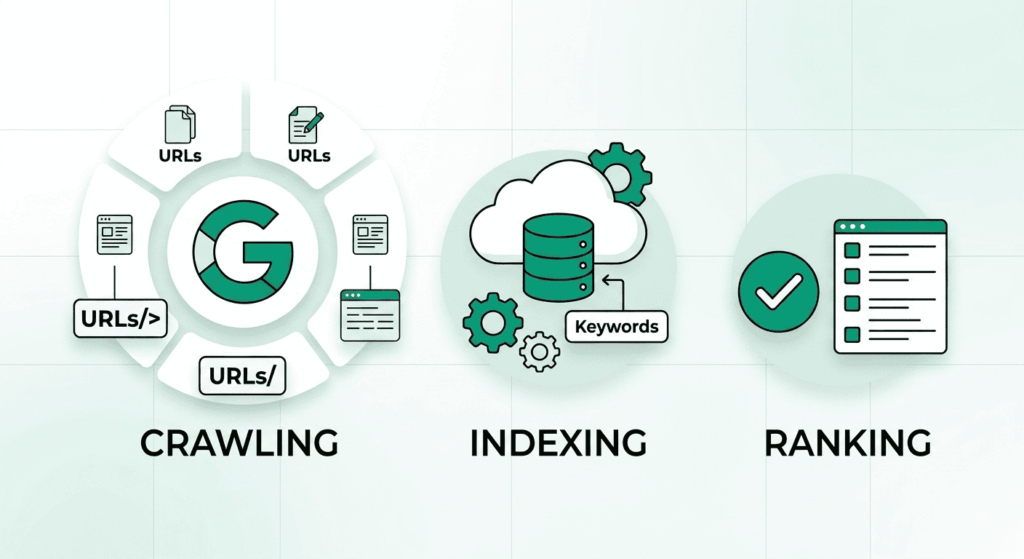
A user enters a query, and the search engine selects materials that may solve the user’s problem most effectively. In simplified terms, this search process consists of three main stages: crawling, indexing, and ranking.
Google also identifies these processes when explaining how search works. The better a website is prepared technically and in terms of content, the easier it is for a search engine to evaluate it and compare it with competitors’ offerings.
Website Crawling by Search Engine Bots
Search engine bots follow links and discover new or updated materials. Technical website optimization should provide search bots with a clear path through the website and access to all important content.
Sources that help search engines discover URLs include:
- internal links;
- links from other websites;
- the sitemap.xml file;
- URLs already known to the search engine.
A URL may remain undiscovered if no links point to it, if it is located too deep within the website structure, or if technical settings restrict bot access.
Page Indexing
After crawling, the search engine analyzes text, images, videos, metadata, and other elements of the material. The collected information may be stored in the index, which is a large search engine database.
For website promotion, it is important to monitor indexing: the search engine should store the current version of the website rather than duplicate or technical URLs.
Publishing a piece of content does not guarantee that it will appear in search results. Indexing may be prevented by a noindex directive, blocked access, server errors, duplicate content, an incorrect canonical tag, or insufficiently useful content.
Website Ranking in Search Results
When a user enters a query, the search engine determines the order of relevant results. This process is called ranking.
Website SEO promotion is aimed at improving the relevance, quality, and authority of a website compared with competitors in a specific search results page.
A single URL may rank differently for different queries because its relevance to the user’s search intent varies. Search relevance, content quality and completeness, website usability, query context, user location, and other signals also affect the result.
Why Does a Website Need SEO Promotion?

Why does a website need SEO promotion? Its purpose is not limited to improving rankings. A business needs interested users, leads, purchases, and revenue, so SEO should be connected to the website’s commercial goals.
Systematic promotion turns the website into a complete marketing asset that develops its search visibility and helps it outperform competitors.
Main SEO Goals
The main goals of website SEO promotion are to:
- increase the company’s visibility in search;
- improve rankings for target queries;
- increase organic traffic;
- generate leads and sales;
- expand the number of entry points to the website;
- reduce dependence on paid advertising;
- increase brand awareness and trust.
Priorities depend on the business. For an online store, sales from certain categories may be the most important indicator, while a B2B company may focus on qualified inquiries generated by narrow commercial queries.
What Is SEO Traffic?
SEO traffic is traffic generated by unpaid search engine results.
It differs from paid traffic because the business does not pay Google directly for every click. However, organic traffic cannot be considered completely free: website promotion requires investment in SEO specialists, developers, writers, editors, and link builders.
SEO traffic is often highly targeted because users have already identified their need. Commercial queries bring in people who are ready to choose a product or contractor, while informational queries attract users who are researching a problem and may contact the company later.
What Does SEO Give a Business?
With the right strategy, website SEO promotion can help a business generate:
- a stable flow of interested visitors;
- new inquiries and customers;
- additional reach across hundreds or thousands of queries;
- growth in the number of pages attracting traffic;
- a stronger brand presence in search;
- a cumulative return from website development.
As the website develops, promotion covers new search clusters, while the website gains more customer touchpoints and becomes less dependent on external advertising.
At the same time, it is important to evaluate not only traffic volume but also traffic quality: which URLs users visit, whether they complete target actions, and whether those actions generate revenue.
Who Is SEO Promotion Suitable For?
SEO is especially relevant for online stores, service websites, corporate websites, directories, marketplaces, informational projects, local companies, and B2B businesses.
Both a new website and an established website that already receives traffic but does not fully use its search potential can be promoted. SEO promotion is especially valuable for websites that plan to develop over the long term, expand their search reach, and compete systematically for demand.
However, SEO should not always be the only or first channel. For example, if demand for a new product has not yet formed, users will not actively search for it on Google. In this case, display advertising, SMM, or other demand-generation tools may be required.
SEO is also unsuitable as the only solution when immediate results are required, the website is intended to operate for a short period, or the company is not prepared to develop the website regularly.
What Is Included in Website SEO Promotion?
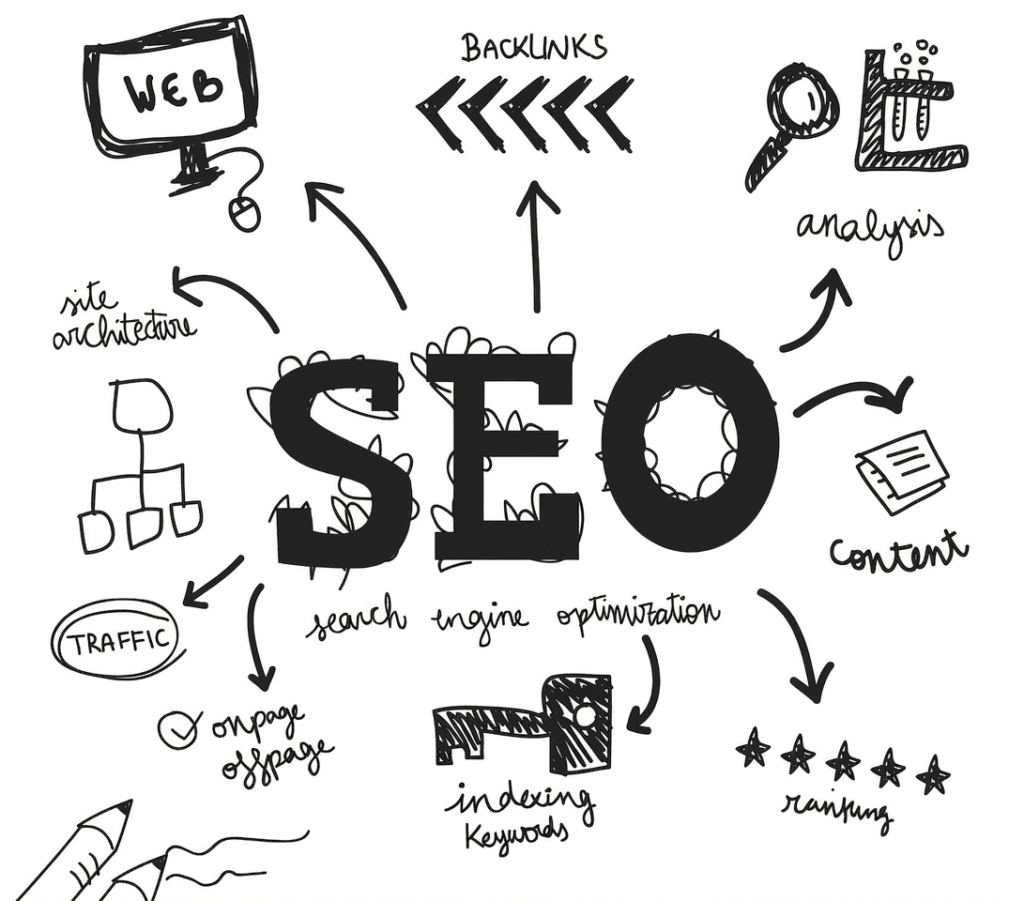
SEO is not a single setting or a one-time content publication. It is a set of interconnected activities.
Comprehensive promotion combines on-site and off-site website optimization: individual activities reinforce one another and create an overall result for the website.
Technical SEO Optimization
Specialists check indexing, robots.txt, and sitemap.xml, remove duplicate content, configure redirects and canonical tags, and identify broken links and incorrect server response codes.
They also optimize website speed, mobile performance, HTTPS, and structured data. This type of optimization makes the website accessible to search engines, reduces technical risks, and creates a foundation for further promotion.
A strong technical foundation is important because crawling or content-processing issues may cause the website to lose a significant share of potential search traffic. Google also recommends making websites secure, fast, accessible, and convenient across different devices.
Keyword Research and Clustering
A semantic core is a set of queries that the target audience uses to search for products, services, or information.
Keyword research shows which topics a website can compete for in search and which promotion areas are most important for the website.
Collected keywords are grouped by meaning and search intent. This clustering helps determine which queries can be promoted within one piece of content and which require separate materials.
Website Structure Optimization
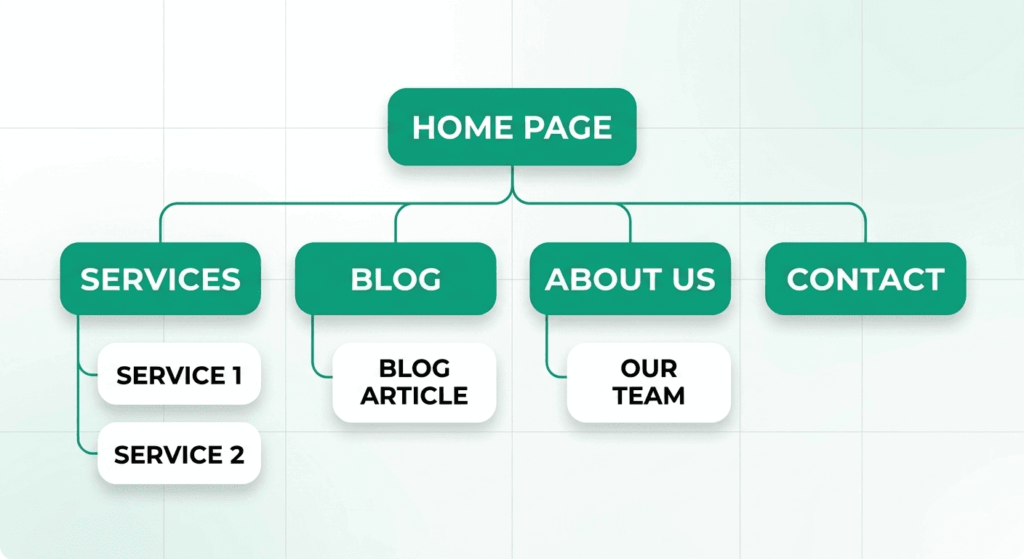
For website SEO promotion, categories, subcategories, service pages, and informational materials are created based on keyword research. A logical hierarchy, clear URLs, breadcrumbs, and internal navigation are developed.
The website structure should reflect search demand, website goals, and the selection logic already used by strong competitors. In large catalogs, each individual page should have a clear place within the website hierarchy.
A well-designed structure helps users find information faster and allows search engine bots to discover pages and understand the relationships between them.
Website Page Optimization
The following elements are optimized for each section:
- Title and Description;
- H1–H6 headings;
- URL;
- main text;
- images and alt attributes;
- commercial or informational blocks;
- structured data;
- internal links.
As a result, SEO optimization of each section strengthens the website, while promotion becomes more closely aligned with search intent. Each page receives its own purpose and target keyword cluster.
All elements should complement one another and accurately reflect the actual content.
Content Optimization
A good SEO text is not created for the mechanical repetition of keywords. It should match user intent, answer the question thoroughly, demonstrate expertise, and help the user make a decision.
For a website, this means creating materials that cover the topic more deeply than competitors while supporting the website’s search promotion. A useful page answers the question without duplicating nearby website content.
Content should be structured logically, supported by reliable data, and updated regularly. Length alone does not guarantee high rankings: Google states that there is no universal minimum or maximum word count required for ranking.
Internal Linking

Internal links help search engine bots discover content, show relationships between materials, and distribute internal link equity. For visitors, they provide an additional route to useful information, a service, or a product.
Proper internal linking strengthens the website structure, supports the promotion of priority sections, and helps search engines understand the website architecture.
Off-Site SEO Optimization
Link-based website SEO promotion includes earning high-quality backlinks and brand mentions.
Off-site optimization should strengthen the website’s reputation: quality mentions help the website compete in search without artificially increasing the number of links.
The number of links is not the only factor that matters. The authority, relevance, and naturalness of referring websites are also important. Mass link building without quality control may look like an attempt to manipulate search results. Google considers links created primarily to influence rankings to be link spam.
Analytics and Performance Monitoring
During promotion, specialists track:
- rankings and visibility;
- impressions, clicks, and CTR;
- organic traffic;
- conversions;
- indexing status;
- technical errors;
- changes in the external backlink profile.
Regular analysis shows how website promotion changes compared with competitors and which elements of website SEO optimization need to be strengthened.
Analytics reveals which solutions work, where the website loses potential traffic, and how the strategy should be adjusted.
Types of Website SEO Optimization
The main types of SEO promotion can be divided into four areas. The choice depends on the website’s market, search demand, and competitors, although on-site and link-based website promotion are usually developed in parallel.
Regardless of the type of work, promotion should strengthen the website as a whole. On-site optimization improves the website itself, while competitor analysis provides reference points for further promotion.
- On-page SEO — technical, structural, and content-related changes made directly on the website.
- Off-page SEO — work with backlinks, mentions, and website authority.
- Local SEO — promotion of a company in a specific city or region.
- International SEO — promotion of multilingual and multiregional projects.
International promotion requires consideration of language, local search demand, external factors, competitors, and the specific characteristics of search results in each country.
For example, when promoting a website in the United States, simply translating existing sections is not enough. It is necessary to study US search results and adapt the structure, keyword strategy, and content to the target market.
Main Principles of SEO Promotion
The foundations of SEO optimization are built around the user. SEO optimization and technical website settings are important, but without useful content and a clear, convenient website, they will not deliver sustainable business results.
These SEO fundamentals help develop the website as a single project in which search accessibility, content, and external authority work together to support promotion.
The main principles of SEO include the following.
Matching User Search Intent
The material should solve the exact task that brought the user to search. For a query with purchasing intent, the user expects to see a product or service. For an informational query, the user expects a clear answer.
If the website does not match the intent, even active promotion and external links will not allow it to outperform competitors consistently.
Useful, High-Quality Content
Website content should be accurate, complete, and clear. It is important to avoid filler, unsupported claims, and texts written solely for the purpose of inserting keywords.
Technical Website Accessibility
Search engine bots should be able to find the page, crawl it, and process the main content. Configuration errors may make useful content invisible in search.
Technical optimization gives search engines access to the website and enables the use of other website promotion tools.
Website Usability
Clear navigation, mobile compatibility, loading speed, readability, and ease of completing a target action all affect website search promotion.
Users should not have to search for the price, contact form, or required section. A convenient website solves audience needs more effectively, supports SEO promotion, and compares more favorably with competitors.
Authority, Trust, and E-E-A-T
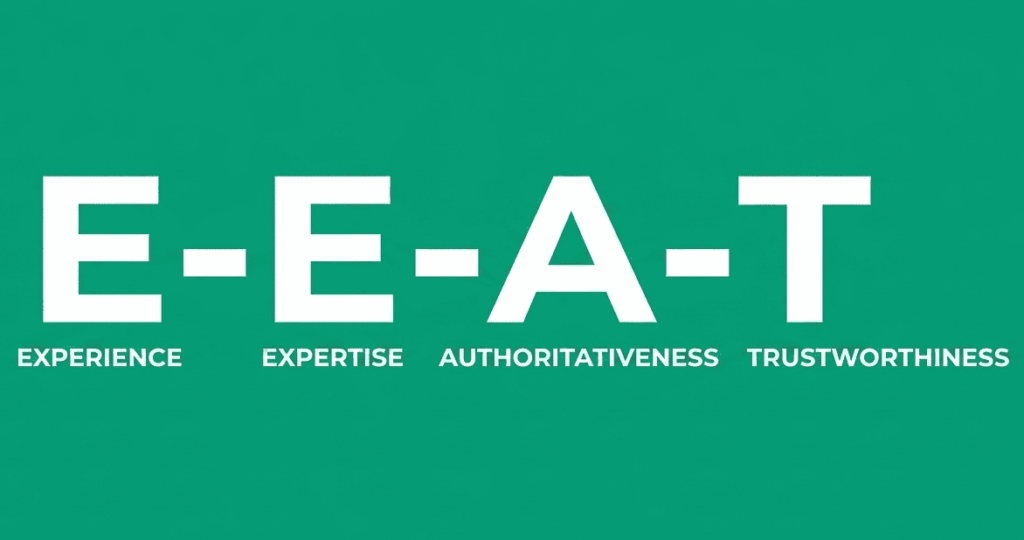
When developing a website, it is important to consider the principles of E-E-A-T:
- Experience;
- Expertise;
- Authoritativeness;
- Trustworthiness.
This is especially important for websites in competitive industries: external mentions and website transparency complement content optimization and strengthen trust among both users and search engines.
Experience can be demonstrated through real case studies, examples of completed work, original research, and practical observations. Expertise can be supported by authors’ qualifications, specialization, position, and professional experience.
Authority is developed through brand mentions in industry sources, publications in specialist media, high-quality external links, reviews, certificates, and the company’s overall reputation.
E-E-A-T is especially important for medical, financial, legal, and other topics where inaccurate information may affect a user’s well-being.
E-E-A-T cannot be improved through a single setting. It is a combination of signals demonstrating real experience, competence, authority, and trustworthiness.
Therefore, E-E-A-T development should include high-quality content, business transparency, confirmation of expertise, and the ongoing development of brand reputation.
Ongoing Development and Analysis
SEO cannot be “configured once and for all.” Search demand, competitors, the website, the project itself, the product range, content, and search engines all change over time.
Therefore, the website SEO promotion strategy must be reviewed and updated regularly. Ongoing promotion allows the website to adapt to new competitors, external changes, and its own development.
Promotion continues after the first results appear: the website must be updated, while optimization should take changes in demand and competitor activity into account. Only then can the website retain its positions.
Stages of Website SEO Promotion
SEO promotion is a sequential process in which each stage is based on the results of the previous one.
You should not begin by publishing large numbers of articles, collect keywords afterward, and fix technical errors only when traffic declines. This approach leads to unnecessary expenses, internal competition between pages, and the need to redo completed work.
Each stage improves the website and reduces its risks, while consistent promotion helps turn separate SEO tasks into a manageable strategy.
The correct website promotion process begins with an understanding of the business, the niche, and search demand. An audit is then conducted, a strategy is developed, technical and content-related changes are implemented, the backlink profile is strengthened, and results are analyzed.
Below is a more detailed explanation of what SEO requires and which steps systematic promotion includes.
1. Defining Goals and KPIs
Before work begins, it is necessary to understand why the business needs SEO and what result it expects. The statement “we want to be at the top” is too general: high rankings alone do not guarantee more inquiries or sales.
Website promotion goals should be measurable, while KPIs should reflect not only search visibility but also the website’s commercial performance.
Goals should be connected to real business objectives. For example:
- increase organic traffic to priority categories;
- attract more inquiries for specific services;
- increase online store sales;
- enter search results for new business areas;
- increase brand visibility;
- reduce dependence on paid search advertising;
- begin promotion in a new region or country.
After the goals are defined, KPIs are selected to measure strategy effectiveness. These may include website visibility, the number of queries ranking in the top positions, organic traffic, conversions, leads, sales, and search-generated revenue.
The starting point must also be considered. For a new website, the first result may be the appearance of pages in the index and growth in visibility. For an established website, the goal may be to increase not just traffic but the number of commercially valuable inquiries.
2. Niche, Demand, and Competitor Analysis
SEO promotion should always begin with niche analysis. This makes it possible to understand how the search market operates, which websites the project will compete with, and which solutions already perform well in search results.
The more accurately competitors are studied, the easier it is to determine what type of website, content, and backlink profile are required for successful promotion.
Competitor comparison helps identify which website a search engine considers the most complete answer. This gives website promotion clear reference points and allows optimization to be based on data rather than assumptions.
Specialists analyze:
- the level and seasonality of search demand;
- target audience behavior;
- the types of queries potential customers use;
- websites that rank highly;
- the structure and number of competitor landing pages;
- the quality and format of their content;
- commercial elements;
- backlink profiles;
- strengths and weaknesses of the top-ranking projects.
Competitors in search results do not always match the company’s direct business competitors. For example, a company may compete for customers with several local brands, while Google results for its target queries may include marketplaces, aggregators, directories, and large informational websites.
Search results analysis helps determine the true scale of the work. It shows whether existing sections only need improvement or whether the website requires an expanded structure, new pages, stronger content expertise, and systematic backlink development.
The purpose of this stage is not to copy competitors, but to understand the requirements of the niche and identify opportunities to make the website more useful, convenient, and persuasive.
3. Comprehensive Website SEO Audit
If the website already exists, its current condition should be assessed before promotion begins. Without an SEO audit, it is impossible to determine which problems are genuinely preventing growth and which tasks should be completed first.
An audit combines technical optimization, content, and off-site promotion into a unified development plan for the website and the overall project.
A comprehensive audit usually includes several areas.
A technical audit identifies crawling and indexing errors, duplicate pages, incorrect redirects, broken links, issues with robots.txt and sitemap.xml, canonical URLs, server response codes, HTTPS, the mobile version, and loading speed.
A structure audit helps determine whether the website architecture matches search demand, whether users can find important sections easily, and whether critical URLs are located too deep within the website.
A content audit shows which materials are outdated, fail to match search intent, overlap with one another, do not cover the topic fully, or lack sufficient expert value.
A keyword analysis identifies the queries the website already ranks for, demand clusters that are not yet covered, and URLs competing with one another.
An external backlink audit is required to evaluate the number, quality, relevance, and dynamics of third-party links.
Initial metrics are also recorded, including rankings, organic traffic, visibility, the number of indexed pages, conversions, and other data. These metrics become the baseline for evaluating future results.
The audit should produce more than a list of errors. It should result in a prioritized plan showing which issues must be fixed immediately, which tasks can generate faster growth, and which changes require more time and resources.
4. Keyword Research
A semantic core is a set of search queries related to the target audience’s products, services, problems, and interests.
For promotion, query volume alone is not enough. The website should cover queries that match its products and allow it to compete for target traffic.
At this stage, specialists study the language users employ to describe their needs. Business terminology and customer language often differ. A company may use a professional term, while potential customers search for the same service using simpler or more conversational wording.
Keyword research takes into account:
- search volume;
- search intent;
- commercial value;
- location;
- seasonality;
- competition;
- relevance to the company’s products and services;
- the user’s decision-making stage.
The keyword strategy should not focus only on high-volume queries. Narrower phrases may generate less traffic, but they often express a more specific need and convert into inquiries more frequently.
For example, a broad query may be used by someone who is only becoming familiar with the topic, while a detailed query that includes the service, city, characteristics, or price may indicate a user who is ready to choose a provider.
The completed semantic core becomes the basis for the future website structure, content plan, and page optimization.
5. Keyword Clustering and Structure Development
After keywords have been collected, they should not be assigned to pages simply because they contain similar words. It is necessary to determine which phrases belong to the same search intent and can be promoted together.
Correct clustering protects the website from internal competition and helps allocate promotion resources more accurately.
Queries are grouped according to:
- meaning;
- intent;
- expected content type;
- search results composition;
- overlap between competitors ranking at the top.
One cluster may require an online store category, while another may require a service page, article, collection, guide, or comparison.
After clustering, the website structure is created or adjusted. The process determines:
- which existing sections should be retained;
- which sections require improvement;
- which new landing pages should be created;
- which materials can be merged;
- which URLs compete with one another;
- how sections should be connected through internal links.
A properly designed website structure covers demand without creating large numbers of nearly identical pages. It also simplifies website scaling: when new services, products, or regions are added, they can be incorporated logically into the existing architecture.
For new projects, this stage should ideally be completed before website development begins. Otherwise, after launch, the company may discover that the navigation, categories, templates, and URLs do not match search demand and require major restructuring.
6. Developing an SEO Strategy and Prioritized Action Plan
After niche analysis, auditing, keyword research, and structure planning, an overall website SEO promotion strategy is developed.
The strategy determines how on-site optimization, content, and off-site promotion will help the project outperform competitors.
A strong strategy connects website promotion with business goals: the website receives clear priority areas, while optimization resources are allocated to tasks with the greatest potential impact. Competitors’ strengths are also taken into account.
The strategy should answer several questions:
- which business areas should be promoted first;
- which URLs have the greatest potential;
- which technical tasks are critical;
- which content should be created or updated;
- which resources are required for implementation;
- how the backlink profile will be developed;
- which metrics will be monitored and how often.
Tasks are prioritized. Problems that prevent indexing and normal website operation are usually addressed first. Pages with high commercial potential are then developed, followed by structural and informational content expansion.
Prioritization is especially important for large projects. Attempting to optimize thousands of pages at once may extend the process and fail to produce a noticeable result.
It is much more effective to select areas where demand, business value, and growth probability create the strongest opportunity.
7. Technical SEO Optimization
At the technical stage, specialists fix errors that prevent search engine bots from finding, crawling, indexing, and correctly interpreting website content.
The more stable the website is, the fewer technical limitations interfere with search promotion and competition with other websites.
Without a technical foundation, website promotion slows down: the website may lose index coverage and traffic. Therefore, website optimization begins by removing limitations that strong competitors have already resolved.
Technical work may include:
- configuring robots.txt and sitemap.xml;
- opening important pages for indexing;
- blocking technical and low-value URLs;
- removing duplicate content;
- configuring canonical tags;
- fixing redirect chains and loops;
- removing broken internal links;
- configuring server response codes;
- migrating to HTTPS;
- optimizing the mobile version;
- improving loading speed;
- correcting JavaScript rendering;
- implementing structured data;
- improving pagination and filters;
- optimizing international website versions.
Technical website SEO optimization does not always move a page directly to the top of search results, but it creates a foundation for future growth. If a search engine cannot process a URL correctly, even strong content and high-quality external links will not reach their full potential.
After changes are implemented, the website must be checked again. Some technical tasks affect large numbers of pages, so implementation errors may create new problems.
8. Landing Page Optimization
The next stage of website promotion is work on individual pages that should attract commercial or informational traffic.
Each landing page should strengthen the website and the project’s promotion by providing a more complete answer than the main competitors’ materials.
A landing page should match user expectations and business goals. Website promotion depends on the quality of every important section.
The website should provide a clearer and more complete answer than its competitors, while optimization helps align content, structure, and the target action.
For each section, specialists determine:
- the primary intent;
- the target keyword cluster;
- its role within the website structure;
- the required content format and length;
- the set of commercial or informational blocks.
They then optimize Title, Description, H1, subheadings, URL, text, images, alt attributes, internal links, and structured data.
However, optimization should not be limited to metadata and keyword placement. A landing page should help the user solve a specific problem.
For a service page, important elements may include a clear process description, benefits, pricing or pricing factors, work examples, guarantees, answers to common questions, and an easy way to contact the company.
For an online store category, the important elements may include product range, filters, specifications, stock availability, prices, delivery information, reviews, and selection guidance.
In other words, SEO optimization applies not only to the website text, but to the entire page as a complete answer to the user’s query.
9. Content Creation and Development
Content optimization helps the website capture informational demand, demonstrate expertise, and support potential customers at different stages of the decision-making process.
Content promotion expands the website, strengthens the project’s expertise, and helps cover search demand already targeted by competitors.
For project SEO promotion, a content plan is created based on keyword research and audience analysis. It may include:
- expert articles;
- guides;
- reviews;
- comparisons;
- answers to frequently asked questions;
- case studies;
- research;
- glossaries;
- product or service selection guides.
Each publication should have a specific purpose. Some materials attract new audiences, others help users select a solution, while others strengthen commercial sections through internal links.
Company experts should be involved in content preparation. A material based solely on rewriting other articles rarely provides additional value.
Practical experience, real examples, original data, and professional commentary make a page more persuasive and useful.
Published materials also require ongoing development. Information becomes outdated, search demand changes, and competitors improve their content. Therefore, content should be reviewed, updated, and expanded regularly.
10. Internal Linking
Internal linking connects website sections into a single system. For website promotion, internal links direct attention to priority sections and strengthen topical relationships within the project.
Links help search engine bots discover new URLs and understand relationships between sections. They also allow users to move to related services, products, and materials.
Internal linking should be logical rather than formal. For example:
- an article can link to a relevant service;
- a general service page can link to more specific service areas;
- a category can link to subcategories and useful guides;
- a case study can link to the service used in the project;
- informational content can link to other articles covering related questions.
It is important to use clear anchor text that matches the content of the target URL and to avoid overloading the text with large numbers of similar links.
11. Off-Site SEO Promotion
Even a well-optimized website may struggle to compete in search results without external authority signals.
Off-site promotion strengthens website authority and helps the project compete in areas where on-site optimization alone is not enough.
Website off-site SEO promotion includes earning links and mentions from other resources. These may include:
- publications in industry media;
- guest expert articles;
- industry directories;
- partner materials;
- research and infographics;
- interviews;
- case studies;
- digital PR;
- natural brand mentions.
Before placement, specialists evaluate the website’s relevance, quality, real audience, traffic, and backlink profile.
A link from an authoritative industry resource is usually more valuable than dozens of placements on unrelated websites.
External link promotion should be gradual and natural. Mass purchasing of similar links to increase metrics quickly may raise risks and fail to produce long-term value.
12. Analytics Implementation and Performance Tracking
Without accurate analytics, it is impossible to understand whether website SEO promotion benefits the business.
Analytics shows the contribution SEO makes to website development and allows the project’s dynamics to be compared with search competitors.
Before active promotion begins, data collection should be configured and analytics systems should be checked to ensure that they record the required events. In addition to traffic and rankings, specialists should track:
- form submissions;
- phone calls;
- purchases;
- items added to cart;
- registrations;
- downloads;
- messenger clicks;
- other target actions.
Data should be analyzed not only for the entire website and each project area, but also by individual sections, page types, countries, devices, and search queries.
For example, overall organic traffic may increase because of articles while the number of inquiries remains unchanged. This does not necessarily mean that SEO is ineffective, but it indicates the need to evaluate audience quality, the user journey, and the relationship between informational content and commercial pages.
13. Performance Analysis and Strategy Adjustment
A project SEO strategy is not a fixed document. After tasks are implemented, specialists evaluate performance and make new decisions.
At this stage, website promotion becomes cyclical: project data is used to adjust optimization, content, and the off-site strategy.
Specialists analyze:
- which URLs and queries are growing;
- where rankings remain unchanged;
- which materials receive impressions but few clicks;
- which URLs generate traffic but no conversions;
- which sections lose visibility;
- whether new search competitors have appeared;
- how demand has changed;
- which technical errors appeared after website updates.
Based on this data, metadata, content, internal linking, structure, commercial elements, and the backlink strategy are adjusted.
Sometimes a page does not grow because its answer is incomplete. In other cases, the reason may be incorrect intent, weak external signals, or a technical issue. Decisions should therefore be based on data rather than assumptions.
14. Scaling Successful Solutions
When the website promotion strategy begins to produce results, it can be scaled.
Scaling makes it possible to expand the website and project promotion while maintaining optimization quality and taking competitor responses into account.
For example, a company may:
- expand the structure for new keyword groups;
- create additional regional materials;
- develop new product categories;
- translate and localize the website for other countries;
- update materials that rank just outside the top positions;
- strengthen content clusters;
- repeat successful content formats;
- improve conversion rates on pages with growing traffic.
Scaling does not mean mechanical duplication. Each new direction should be assessed based on demand, competition, and business value.
As a result, the stages of website SEO promotion form a continuous cycle:
analysis → strategy → implementation → measurement → improvement → scaling.
SEO effectiveness does not depend on one “secret” tool. It depends on how consistently and professionally all stages of website promotion are completed.
A systematic approach makes it possible not only to improve rankings temporarily, but also to create a sustainable channel for attracting the target audience and developing the business.
Where Should Website SEO Promotion Begin?

A new website should ideally be prepared for promotion before development begins.
The starting point depends on the condition of the website, but every project should first evaluate search demand, competitors, and technical readiness for optimization.
The first actions determine future promotion: the website is checked technically, compared with competitors, and supported by a clear action plan. After this, website optimization becomes consistent and promotion becomes measurable.
The recommended sequence is:
- study demand and competitors;
- collect keywords;
- design the website structure;
- build a technical SEO foundation;
- create landing pages;
- prepare content;
- connect analytics;
- begin off-site promotion.
At Svitli Agency, we incorporate the necessary SEO conditions directly into the architecture of the websites we develop. This approach helps avoid expensive structural redevelopment after launch.
For an existing website and an active project, the first step is to record current metrics, conduct an audit, identify problems and materials with the greatest potential, and then create a prioritized implementation plan.
Can You Perform SEO Optimization Yourself?
The owner of a small website can configure basic metadata, improve texts, add internal links, and connect analytics independently.
However, comprehensive website SEO promotion often requires an SEO specialist, developer, analyst, writer, editor, and link builder.
Independent promotion may be possible for a small website, but a complex project usually requires a team that can combine on-site and off-site optimization.
There are no universal “secrets” in SEO. The main secrets of SEO optimization are consistency, high-quality analysis, correct prioritization, and regular work.
When a business does not have an internal team, it can order comprehensive website SEO promotion from Svitli Agency. The service combines auditing, keyword research, on-site optimization, content, external links, analytics, and reporting.
Basic Website SEO Optimization Checklist
Check whether the basic requirements have been met. This checklist helps quickly assess whether the website is ready for promotion and which optimization tasks should be completed before off-site work begins:
- the website is accessible for crawling;
- important URLs are open for indexing;
- sitemap.xml and robots.txt are configured;
- HTTPS is used;
- there are no critical duplicates or broken links;
- the website is mobile-friendly;
- materials load fast enough;
- keyword research has been completed;
- queries have been assigned to pages;
- unique Title, Description, and H1 tags are configured;
- content matches search intent;
- images are optimized;
- internal linking is configured;
- analytics systems are connected;
- traffic, rankings, and conversions are tracked;
- a high-quality external backlink profile is being developed.
Advantages and Disadvantages of SEO Promotion
| SEO Advantages | SEO Disadvantages and Limitations |
| Targeted organic traffic. Attracts users with clear intent. | Results do not appear immediately. The first meaningful results often require 3–6 months. |
| Long-term cumulative effect. Traffic may continue even after a pause in active work. | Ongoing work is required. Website promotion requires regular updates, development, and monitoring. |
| Reduced dependence on advertising. Helps lower customer acquisition cost over the long term. | A team is often required. Promotion may involve SEO specialists, developers, writers, and other professionals. |
| Scalability. Makes it possible to attract users to hundreds or thousands of pages. | No guarantees. Search engine algorithms are updated regularly, and rankings may change. |
SEO should not be seen as a quick way to reach first place. It is an investment in long-term visibility, website quality, and a sustainable audience acquisition channel.
For a project, SEO promotion is valuable because it develops the website, strengthens search visibility, and reduces dependence on external advertising channels at the same time.
When Do SEO Promotion Results Appear?
There is no universal timeframe. The speed of website SEO promotion depends on:
- domain age and history;
- website condition;
- level of competition;
- number of technical errors;
- quality and volume of existing content;
- external backlink profile;
- promotion region;
- speed of recommendation implementation.
Timing also depends on competitors: the stronger their websites, content, and external profiles are, the more resources project promotion will require.
Promotion moves faster when the website is technically ready and developed regularly. If competitors are stronger, website optimization requires more resources and promotion takes longer.
The first positive changes may appear gradually, but sustainable growth usually requires long-term, systematic work.
Promises to place any website at the top within a few weeks should be treated critically.
How to Measure SEO Effectiveness
Main SEO Promotion Metrics

Promotion effectiveness should be evaluated at both the website and business levels: search growth should generate target actions for the project, not just rankings.
The result of an individual page should be evaluated together with the performance of the entire website. Website promotion is measured by how effectively the website attracts and converts the target audience.
Competitor comparison shows actual growth, while optimization can be directed toward the website sections with the greatest potential.
The main metrics include:
- organic traffic;
- website visibility;
- rankings;
- impressions and clicks;
- CTR;
- number of indexed pages;
- conversions;
- leads and sales;
- revenue from organic search;
- quality of the external backlink profile.
For each project, the set of KPIs should match the business model. For example, reach and engagement may be important for an informational project, while a service website should focus on inquiries and their cost.
Why Rankings Are Not the Only Metric
A high ranking for an irrelevant query may not generate a single inquiry. At the same time, a page ranking lower for a commercially valuable query may generate sales.
Therefore, SEO should be evaluated as a chain:
visibility → target traffic → conversions → financial results.
Common SEO Optimization Mistakes
Results are often limited when website promotion is carried out in fragments, without competitor analysis, project goals, or a connection between on-site and off-site optimization.
The most common mistakes include:
- promotion without a strategy or measurable goals;
- using queries without considering search intent;
- over-optimizing texts;
- ignoring technical errors;
- creating competing pages for the same cluster;
- copying competitors’ materials;
- purchasing large numbers of low-quality links;
- evaluating work only by rankings;
- expecting immediate results;
- stopping website development after reaching the top.
It is especially dangerous to implement changes without understanding their priority. In some cases, fixing several technical errors can benefit the project more than publishing dozens of new articles.
White Hat, Gray Hat, and Black Hat SEO

White Hat SEO Methods
For sustainable website promotion, it is safer to improve project quality than to try to outperform competitors quickly through external manipulation.
White hat SEO is based on improving the website’s technical condition, structure, content, usability, and authority without violating search engine rules.
A website SEO promotion strategy should be built around quality, detailed project work, competitor analysis, and long-term results rather than the repetitive implementation of identical solutions.
Gray Hat SEO Methods
Gray hat methods are approaches that may not be explicitly prohibited but are created primarily to influence algorithms.
These solutions may generate temporary results, but they increase risks when search engines or external conditions change.
Black Hat SEO Methods
Black hat methods include:
- hidden text;
- cloaking;
- automated spam;
- doorway pages;
- mass unnatural links;
- hacking websites to place links.
Google explicitly treats cloaking, doorway abuse, and link schemes as violations. The consequences may include reduced visibility or the removal of individual pages and sections from search results.
Modern SEO Trends: How Artificial Intelligence Is Changing Search
Traditional SEO continues to evolve. In addition to work on a website’s technical condition, keyword strategy, content, and links, optimization now needs to consider new search promotion formats.
Increasingly, users receive not only a list of pages but also an AI-generated answer directly in search results.
AI changes the format of search results, but it does not eliminate website promotion. Search engines still evaluate technical optimization, content, external authority, and project competitiveness.
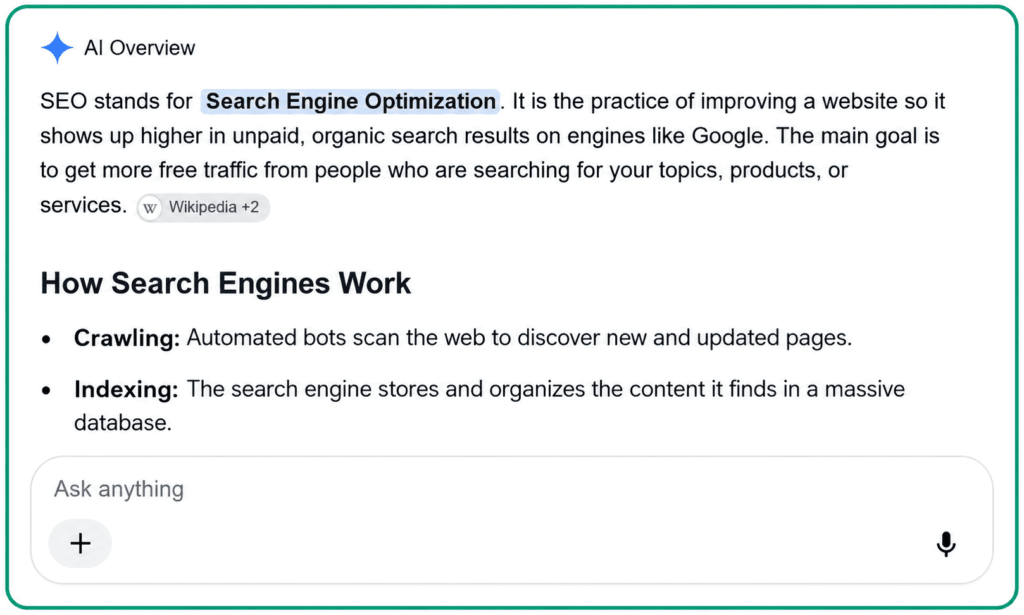
AI systems can collect information from several sources, answer a question briefly, and suggest links for further research.
For this reason, content should be clear and well structured: it should provide direct answers and use logical headings, lists, tables, definitions, examples, and verified facts.
This makes the material easier to analyze for users, search engines, and AI systems.
However, the appearance of AI-generated answers does not replace traditional SEO optimization. For a page to be used in Google’s AI features, it must be indexed and meet the basic requirements of regular search.
Google also emphasizes that standard SEO recommendations remain relevant for AI Overviews and AI Mode, and that there is no separate “secret” optimization method for appearing in such answers.
It is therefore incorrect to assume that a new project or website without a well-developed structure, technical optimization, and high-quality content can be promoted in AI-generated results immediately.
If a search engine cannot crawl, index, and understand the content properly, the likelihood of it appearing in either traditional results or AI-generated answers will be significantly lower.
SEO remains the foundation: first, the website must be technically accessible, useful, expert, and authoritative. Only then should the business work additionally on its visibility in new AI-powered search formats.
Frequently Asked Questions About SEO
What Is SEO in Simple Terms?
SEO is work performed on a website to help search engines understand its materials and show them to users for relevant queries.
What Is Included in Website SEO Promotion?
It includes auditing, technical optimization, keyword research, structure development, page optimization, content creation, internal linking, external links, and analytics.
How Is SEO Different From Paid Search Advertising?
SEO develops a website’s organic visibility gradually, while paid search advertising can generate paid traffic almost immediately after a campaign is launched.
Where Should SEO for a New Website Begin?
It should begin with demand and competitor research, keyword collection, and structure planning. Technical SEO requirements should ideally be taken into account during the development stage.
Can First Place in Google Be Guaranteed?
No. Rankings are determined by search engine algorithms and depend on many factors, including competition, page quality, and changes in search results.
Should SEO Continue After the Website Reaches the Top?
Yes. Competitors continue developing their websites, demand changes, and new URLs and technical errors appear. Without ongoing work, achieved rankings may be lost.
How Can You Tell Whether SEO Benefits the Business?
You should evaluate not only rankings but also targeted organic traffic, inquiries, sales, revenue, and customer acquisition cost.
Will Artificial Intelligence Replace SEO Promotion?
No. AI does not replace SEO; it changes it. Users still search for reliable services and products.
AI-generated answers in Google, including AI Overviews, are built using information from high-quality, optimized websites. This makes SEO even more important for appearing in such recommendations.

 Oleksiy

 Oleksiy