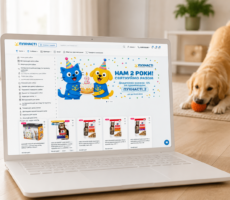
The client approached us with the task of migrating their online store from Magento to OpenCart. The previous CMS had become a limitation for the business: any changes were expensive, it was difficult to find a contractor for support, and some important tasks remained unfulfilled.
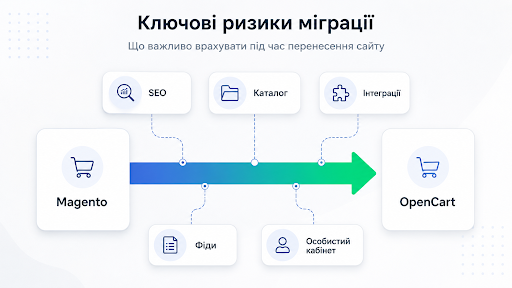
We migrated the website to OpenCart, preserved the important SEO structure, set up redirects, metadata, product feeds, integration with inventory management and CRM, delivery via Nova Poshta, payment through LiqPay, e-commerce, Merchant Center, filtering, landing pages for filters, promo banners in categories, and convenient display of product options.
We migrated the website to OpenCart, preserved the important SEO structure, set up redirects, metadata, product feeds, integration with inventory management and CRM, delivery via Nova Poshta, payment through LiqPay, e-commerce, Merchant Center, filtering, landing pages for filters, promo banners in categories, and convenient display of product options.
- Expensive modifications
- Difficult to find a contractor
- Unresolved technical issues
- Marketing limitations
- More difficult catalog maintenance
- Migrated the site to OpenCart
- Preserved the SEO structure
- Set up redirects and metadata
- Integrated feeds, Merchant Center, and e-commerce
- Implemented filters, landing pages, and promo banners
- Added a pet profile questionnaire in the user account
- Flexible website for growth
- Easier management and support
- Ready for SEO promotion
- New opportunities for product advertising
- Sales and user behavior analytics
- A base for personalized offers
The main task was to migrate the website from Magento to OpenCart so that the online store became easier to maintain, less expensive to develop, and more convenient for the client’s team.
The following needed to be implemented:
- migration of the catalog, products, attributes, filters, and content;
- preservation of the SEO URL structure where possible;
- setting up redirects for pages whose addresses have changed;
- generation and migration of metadata;
- product feeds for advertising and shopping platforms;
- synchronization with inventory management and CRM;
- delivery via Nova Poshta;
- payment via LiqPay;
- filtering and landing pages for filters;
- promo banners in categories and on manufacturer pages;
- convenient display of product options;
- a personal account with additional features for users;
- setup of Merchant Center and e-commerce.
The client’s technical specification also included tasks related to multilingual support, feeds for Google Merchant, Rozetka, Prom, operations with products, brands, filters, checkout, personal account, robots, sitemap, template meta tags, and URL structure.

The old site was running on Magento. For a large online store, this is not always a problem in itself, but in this project, the CMS began to hold back business growth.
Main challenges:
- high cost even for minor improvements;
- difficulty finding a contractor to support Magento;
- accumulated unresolved tasks;
- the need to safely migrate the site without losing SEO positions;
- a large catalog with products, attributes, filters, and variants;
- a need for integrations with inventory management, CRM, payment, delivery, and advertising platforms.
What we did
1. Migrated the website to OpenCart
We migrated the online store to OpenCart so that the client could have a more flexible system for daily website management.
Now the team can work more easily with products, categories, pages, banners, promotions, SEO settings, and content without constant dependence on complex and expensive development.
2. Preserved SEO structure and set up the technical SEO foundation
We considered SEO not after the launch, but already at the development stage.
We:
- preserved the URL structure where possible;
- set up redirects for pages that changed their address;
- migrated and configured metadata;
- implemented a metadata generator;
- checked robots.txt;
- prepared a sitemap;
- took into account SEO requirements for categories, products, and filter landing pages.

3. Implemented Convenient Display of Product Variants
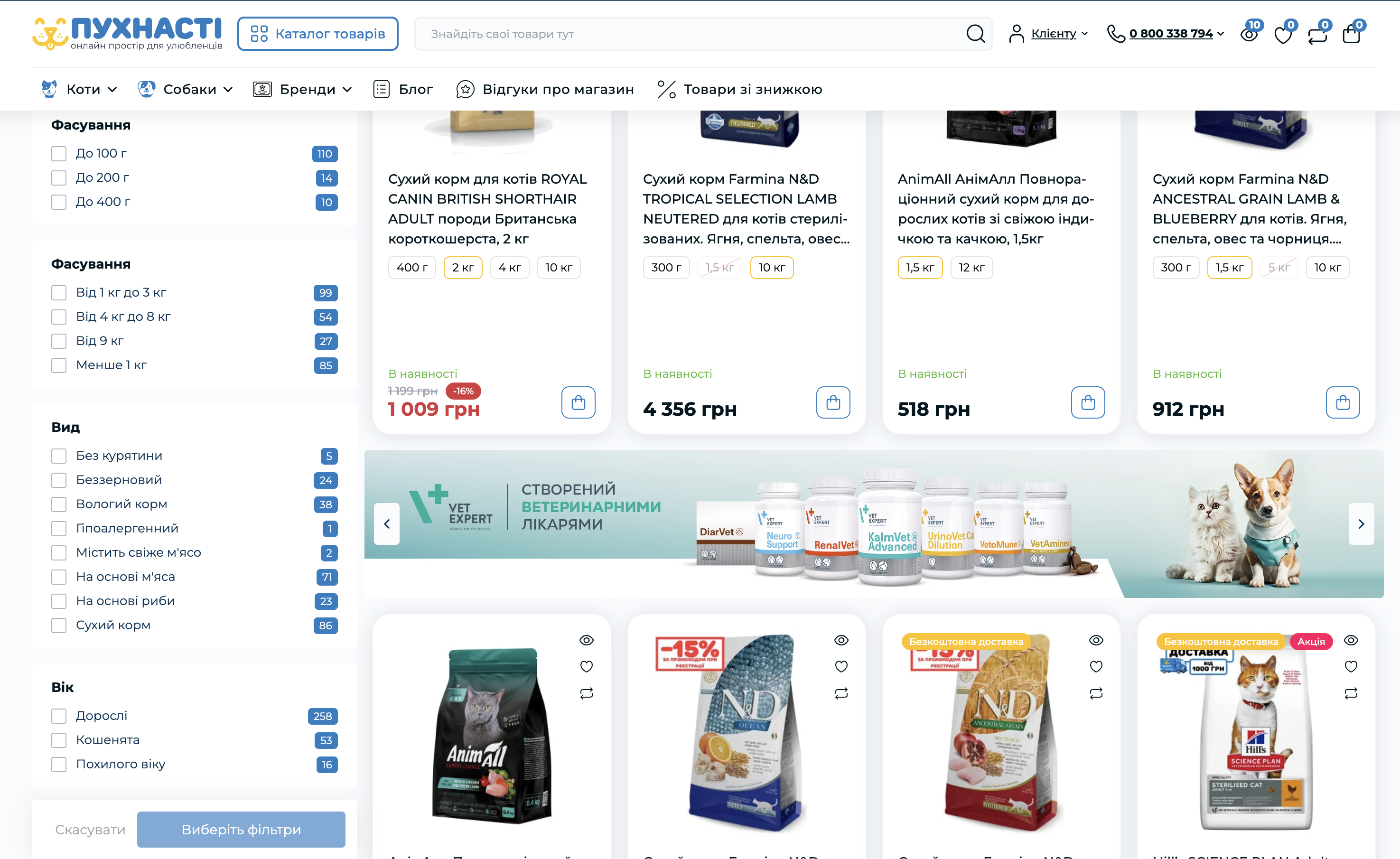
For products with different variants, we implemented linking individual products into one logical group. For example, if a product has different options by weight, size, color, or another characteristic, the user sees this as a convenient switcher in the product card. At the same time, each variant can remain a separate product with its own price, stock, photo, characteristics, and SEO logic.
What this gives the business:
- it is easier for the user to choose the desired variant;
- switching happens quickly, without page reloads;
- each product variant can have its own price and stock;
- filtering works better with linked products;
- the catalog becomes more convenient for both users and administrators;
- you can properly manage canonicals and avoid SEO duplication.
4. Added Promo Banners in Categories and on Manufacturer Pages
We implemented the ability to add promo banners directly within categories and on manufacturer pages. The banners are integrated into the general product list and look like an organic part of the catalog.
This gives the marketing team more opportunities:
- to promote promotions, new arrivals, sales, and seasonal offers;
- to highlight specific brands or categories;
- to guide users to target pages;
- to quickly update banners without code edits;
- to configure banners for different language versions of the site.
5. Implemented Synchronization with Inventory Management and CRM
We set up data exchange between the website, inventory management, and CRM. This allows you to automate work with products, stock levels, orders, and customer data.
For business this means:
- less manual work for managers;
- more up-to-date stock information on the site;
- fewer mistakes in orders;
- faster order processing;
- more convenient sales workflow.
6. Set Up Nova Poshta Delivery and LiqPay Payments
We integrated Nova Poshta delivery and online payments via LiqPay.
This helps make checkout familiar and convenient for users: they can choose delivery options, pick-up method, and pay for their order online.
For business, it shortens the path to purchase and reduces the number of manual actions during order processing.
7. Set Up Filtering and Filter Landing Pages
For a large catalog, filtering is not just a convenience but an important sales tool.
We implemented filters that help users find the right product by parameters faster. The faster a person finds a relevant product, the higher the probability of purchase.
Separately, we implemented filter landing pages. This is important for SEO because such pages can be used for precise commercial queries.
For example, a user may search not just for a general category but for a specific type of product, brand, parameter, or combination of features. Filter landing pages allow you to create separate pages for such queries with relevant URLs, metadata, and content.
What this gives the business:
- more entry points from organic search;
- opportunity to promote narrow commercial queries;
- better relevance of pages for users;
- a more convenient path to purchase;
- potential growth in SEO traffic.
8. Set Up Product Feeds
We set up feeds for transferring products to advertising and shopping platforms.
Sure! Here is your translated text with the original HTML formatting preserved: “`html
For business, this provides the opportunity to:
- launch product advertising;
- transfer up-to-date prices and stock levels;
- scale sales through external channels;
- reduce manual preparation of product data;
- update product information on various platforms faster.
9. Set up Merchant Center
We set up Merchant Center so that products from the online store could be properly transferred to Google Shopping and other product advertising formats.
What this gives you:
- the ability to launch product campaigns;
- display products in Google Shopping;
- timely transfer of prices and availability;
- an additional sales channel;
- better presentation of products in ads.
10. Set up e-commerce
We set up e-commerce so that the business could not only see website traffic, but also real user actions on the path to purchase.
E-commerce allows you to track:
- product views;
- adding products to cart;
- starting checkout process;
- purchases;
- revenue;
- the effectiveness of products, categories, and advertising channels.
11. Added a pet profile questionnaire in the personal account
We have implemented a pet profile questionnaire in the personal account. The user can add information about their pets: for example, species, breed, age, dietary preferences, or other parameters that are important for product selection.
This is not just an additional feature in the account, but a foundation for future personalization.
What this gives to the business:
- the ability to better understand customer needs;
- to personalize product recommendations;
- to offer relevant promotions;
- to segment the audience;
- to create more accurate email campaigns;
- to increase repeat sales.
For example, if a user has a cat of a certain age or a dog of a specific breed, the store will be able to offer them more relevant food, accessories, grooming products, or preventive goods in the future.
The client received an online store on OpenCart, which is easier to maintain, develop, and scale.
We completed the key tasks that remained unresolved on the old site:
- migrated the site from Magento to OpenCart;
- preserved the SEO structure where possible;
- set up redirects;
- implemented a metadata generator;
- configured product feeds;
- connected Merchant Center;
- set up e-commerce tracking;
- implemented synchronization with warehouse management and CRM;
- connected Nova Poshta delivery service;
- enabled payments via LiqPay;
- implemented filtering and filter landing pages;
- added promo banners in categories and on manufacturer pages;
- implemented convenient product variant switching;
- added a pet profile questionnaire in the user account.
The main value of the project is that we helped the business transition to a more manageable e-commerce system, where the site can be developed faster, maintained more easily, and used not only as a catalog but as a full-fledged sales, analytics, and personalization tool.
 Vika
Vika
 Vika
Vika